
AI for Inventory Management: What it is, Use Cases, Key Benefits
What Does AI for Inventory Management Actually Mean?
AI for inventory management refers to machine learning models, predictive analytics, and AI-assisted tools applied to the planning, optimization, and execution of inventory decisions. It includes demand forecasting algorithms, automated replenishment systems, dynamic safety stock models, and AI assistants that support the communications and reporting work of inventory teams.
The core problem AI addresses in inventory management is the tension between service level and working capital. Too much inventory costs money in carrying costs, obsolescence risk, and warehouse space. Too little costs money in stockouts, lost sales, and expedite fees. AI models that more accurately predict demand and optimize replenishment decisions can reduce both simultaneously.
For inventory professionals evaluating AI tools, the most important distinction is between AI that optimizes quantitative planning decisions (forecasting, replenishment, safety stock) and AI that assists with the knowledge work surrounding inventory operations (supplier communications, vendor escalations, reporting). Both categories are valuable and both are well represented in the current AI tool market.
The Main AI Applications in Inventory Management
Demand Forecasting
ML-based demand forecasting is the most mature and widely deployed AI application in inventory management. Models trained on historical sales data, seasonality patterns, promotional calendars, and external signals consistently outperform traditional statistical methods for most SKU categories.
Automated Replenishment
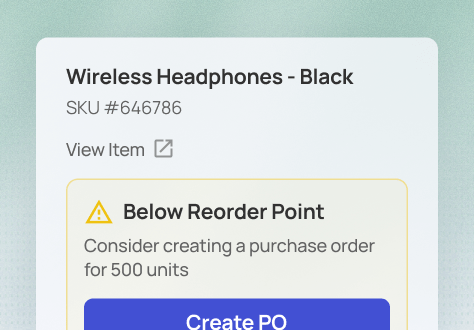
AI-assisted replenishment systems use demand forecasts, lead time variability models, and supplier performance data to generate purchase orders and transfer recommendations automatically. The best systems improve over time by learning from forecast errors.
Dynamic Safety Stock Optimization
AI models that account for demand variability, lead time variability, and service level targets dynamically — adjusting safety stock levels by SKU and location — reduce both carrying costs and stockout risk compared to static methods.
Inventory Positioning & Network Optimization
For multi-location distribution networks, AI models that optimize where inventory should be positioned — accounting for transportation costs, demand patterns, and service level requirements by region — can reduce total inventory investment and transportation costs simultaneously.
Inventory Reporting & Exception Management
AI tools that summarize inventory KPIs, flag stockout risks, identify slow-moving or excess inventory, and generate structured exception reports reduce the manual data compilation burden for inventory analysts and planners.
Where AI Delivers Measurable Value in Inventory Management
- Forecast accuracy improvement: Well-implemented ML demand forecasting typically improves forecast accuracy by 20–40% over traditional methods, particularly for high-variability SKUs.
- Safety stock reduction: More accurate demand forecasts and lead time models allow for lower safety stock buffers without sacrificing service levels.
- Stockout rate reduction: AI-assisted replenishment that accounts for demand and lead time variability reduces stockouts for high-velocity SKUs.
- Slow-moving and excess inventory identification: AI tools that flag inventory at risk of obsolescence earlier allow for earlier intervention.
- Planner productivity: AI tools that automate replenishment recommendations free inventory planners from data compilation work.
The Honest Limitations of Inventory AI
- Data quality dependency: ML demand forecasting requires clean, consistent historical demand data. Organizations with poor data quality will see limited benefit until data infrastructure is improved.
- New product forecasting: ML models trained on historical data struggle with new product forecasting where no history exists. Hybrid approaches are required for product launches.
- Demand volatility: During periods of extreme demand volatility, models trained on historical patterns can produce poor forecasts. Human judgment remains essential during high-disruption periods.
- Implementation complexity: Enterprise inventory AI platforms typically require ERP integration — a timeline and cost often underestimated in initial business cases.
Evaluating AI Tools for Inventory Management
- True ML vs. rule-based automation: Ask whether the model learns from forecast errors and improves over time. If not, it's rule-based automation — valuable, but not AI in the meaningful sense.
- Integration requirements: Most enterprise inventory AI platforms require ERP integration. Understand what data the tool needs and where it comes from before committing.
- Forecast accuracy benchmarking: Request a pilot comparing the tool's forecast accuracy against your current method on historical data.
- Planner interface and adoption design: Inventory AI tools that produce recommendations planners don't understand or trust will not be adopted. Evaluate explainability alongside accuracy.
How briefli Can Help
Inventory and supply chain teams generate significant volumes of supplier communications, vendor escalations, purchase order correspondence, and performance reports alongside their core planning work. The briefli product suite handles this knowledge work layer — letting inventory professionals focus on planning decisions rather than administrative tasks.
briefliChat (AI Assistant)
briefli's core AI assistant helps inventory and supply chain teams draft supplier follow-ups, shortage escalations, vendor performance communications, and inventory exception reports. Purpose-built for logistics and supply chain professionals, it produces accurate, professional output on first generation with no setup required.
Briefli SideKick (Email Assistant for Microsoft)
briefliSideKick brings AI-powered email assistance directly into Microsoft Outlook. For inventory and procurement teams managing high volumes of supplier correspondence, SideKick drafts, refines, and replies to emails without leaving the inbox — reducing the daily communication burden for any supply chain team running on Microsoft 365.
briefliDocs (Intelligent Document Processing)
briefliDoc is our IDP solution built for the document-intensive workflows of inventory and supply chain operations. It extracts and processes structured data from purchase orders, supplier contracts, delivery confirmations, and compliance documents — reducing manual data entry and accelerating document-driven procurement workflows.
Frequently Asked Questions About AI for Inventory Management
Is AI inventory management only for large enterprises?
No. While enterprise AI platforms require significant investment, mid-market and SMB-focused inventory optimization tools are widely available. The appropriate tool depends on your SKU count, inventory complexity, and data maturity — not company size alone.
How long does it take for an ML inventory model to learn effectively?
Most ML demand forecasting models need a minimum of 12–24 months of clean historical demand data to produce reliable seasonal forecasts. Model accuracy typically improves over the first 3–6 months of live deployment.
Can AI inventory tools handle multi-location distribution networks?
Yes. Multi-location inventory optimization is one of the strongest use cases for AI over traditional methods. AI models that optimize inventory positioning across a distribution network can produce significant working capital and service level improvements.
Does AI inventory management replace inventory planners?
AI is shifting the work of inventory planners, not eliminating the role. The tasks most at risk of automation are repetitive data compilation, standard replenishment calculations, and routine exception flagging. Strategic inventory positioning decisions remain human-driven.
Keep learning
AI for Customs Brokerage: Applications, Benefits, and What to Evaluate

AI for Route Optimization: How AI Is Improving Delivery Performance and Reducing Costs

AI for Purchasing: How AI Is Changing the Way Teams Buy
.png)